365 Characters with “Chinese in Russian”
Learning Chinese writing can feel like endlessly memorizing thousands of complex symbols. In fact, most characters follow quite specific rules.
Understanding their structure, learning to write them stroke by stroke and spotting recurring elements makes memorization much easier.
This is the idea behind «365 Characters with Chinese in Russian». It does not replace a Chinese textbook, but develops a fundamental skill: mindful writing, which also builds visual memory, attention to structure and understanding of Chinese writing principles.
Why learn to write characters by hand?
Today, Chinese is typed on computers and smartphones more often than written with brush or pen. This sometimes leads people to say handwriting no longer matters.
In practice, the opposite is true.
When you form each stroke yourself, your brain remembers both the character’s appearance and its internal structure. You begin distinguishing similar characters, recognize them more quickly in text and reproduce them from memory more confidently.
Writing becomes not an end in itself, but one of the most effective ways to learn the writing system.
Why do people forget characters so quickly?
Almost every beginner encounters this problem.
You open an app, review flashcards or copy a new character several times. It seems memorized. A few days later, you cannot write it without a prompt.
Poor memory is usually not the reason.
More often, you remember only the overall outline without understanding how the character is built. Without a grasp of stroke sequence and components, memory does not hold it for long.
The workbook therefore aims not to increase mechanical repetition, but to teach you to see each character’s internal structure.
How the method works
Each new character is studied step by step.
Step one. Learn the character’s meaning.
Step two. Analyze the correct stroke order.
Step three. Build the character gradually, adding just one new stroke in each successive square.
Step four. Once the sequence is clear, write the complete character several times.
Step five. Reinforce reading, pronunciation and usage with the website’s dictionary entry.
This develops lasting writing skills rather than mechanical copying.
Why the workbook is linked to the website
Each practice page belongs to a broader learning system.
At the bottom of each character’s page is the address of its entry on «Chinese in Russian». Opening it gives you much more than fits on paper (not to mention things paper cannot convey):
- an animation of correct stroke order;
- a recording of standard pronunciation;
- the character’s meaning;
- radical information;
- stroke count;
- examples of words and expressions;
- additional information to help explain its structure.
The workbook and website thus complement each other as one self-study system.
Why exactly 365 characters?
The workbook contains 365 characters most important for beginners, divided into four roughly equal parts and selected for the early learning stage, close to HSK 1–2 requirements.
Learning just one or two new characters a day, within a few months you will confidently read many simple texts and understand the structure of a substantial proportion of the most common characters.
Try it free
The best way to evaluate the method is to try it.
Download the free sample page for 学 («to study»; the link opens in a new window), take an ordinary squared notebook and complete the first few exercises.
Rule the page into squares about 1.5 × 1.5 cm (3 × 3 notebook squares), as illustrated below. Use a fine pencil for the grid and a fine-tip ballpoint pen for writing.
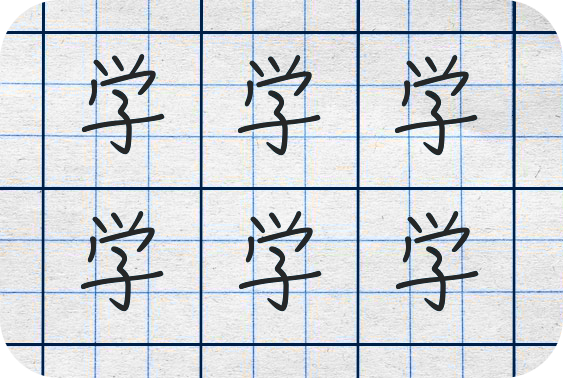
How to use the workbook
Begin by building the character gradually, adding just one stroke in each new square. Once the sequence is clear, write the whole character across several lines.
Then open its dictionary entry, watch the stroke-order animation, listen to the pronunciation and repeat it aloud.
The ideal pace is one or two new characters a day. This fits easily around work or study and gradually establishes lasting handwriting skills.
What the set contains
The full workbook consists of four independent parts.
Each part has worksheets for 91 characters, including:
- readings in Cyrillic (Palladius) and Latin letters (Pinyin);
- the radical;
- stroke count;
- a stroke-order diagram;
- independent practice exercises;
- links to dictionary entries for learning pronunciation as well as written forms.
The complete set covers 365 common beginner characters in four logical blocks:
- Part I—«I am learning to write Chinese characters»;
- Part II—«I am beginning to talk about the world around me»;
- Part III—«I can describe people, actions and events more freely»;
- Part IV—«I can independently read and write significantly more complex texts».
Who the workbook is for
It will help if you:
- are just beginning Chinese;
- want to write characters correctly rather than trace their outlines;
- are preparing for beginner HSK exams;
- are studying Chinese independently;
- want to understand Chinese writing better.
Understanding, rather than rote memorization, underpins the course
Chinese characters seem complicated only while you view them as thousands of unrelated pictures.
Characters are written, not drawn.
Once you recognize recurring elements (graphemes), understand radicals, follow correct stroke order and gradually connect form with sound and meaning, learning becomes both more meaningful and far more enjoyable.
This website is called «Chinese in Russian»because it aims not merely to give information about Chinese, but to reveal the inner logic of its writing system and make it understandable to Russian-speaking readers. The «365 Characters» workbook is a practical extension of that idea.